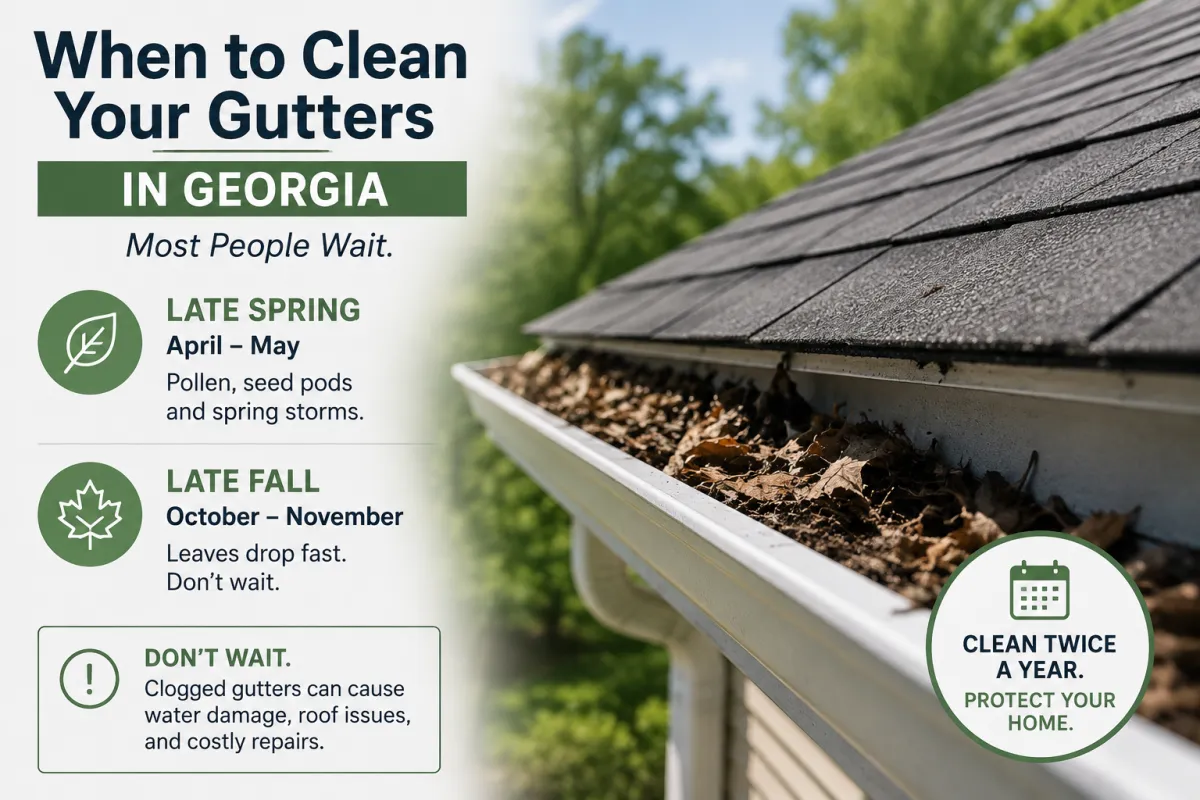
When to Clean Your Gutters in Georgia (Most People Wait)
Overview
Knowing when to clean gutters in Georgia comes down to two specific windows, and most homeowners miss both. Nearly every home here needs gutters cleaned at least twice a year: once in late April to early May after pollen season ends, and once in late October to early November after the hardwood leaves have finished dropping. Homes under heavy oak, sweet gum, or pine coverage often need three or four cleanings a year to keep up. Waiting past those windows lets water back up behind the fascia and siding, and that is where a fifteen minute overflow turns into a rot and mold repair bill.
Gutters overdue? Grime Fighters serves Canton, Woodstock, Jasper, and Ball Ground. Get a free estimate and get it handled before the fall rain.
Why Georgia Gutters Clog Twice a Year
Spring Pollen and the Sludge It Leaves Behind
Everybody in Cherokee County knows what late March looks like. The yellow film on the cars, the haze in the air, the two weeks where nobody wants to be outside.
What people do not think about is where all of that ends up. Pine pollen lands on the roof, rain washes it into the gutters, and it settles at the bottom of the trough. It does not blow out the way dry leaves do. It packs into a dense yellow-brown sludge that holds water and traps everything landing on top of it for the rest of the year.
That sludge layer is the foundation of the clog. By itself it may not stop your downspouts, but it is what turns a manageable amount of summer debris into a solid plug. Clear it out in early May and the gutters go into summer clean.
Fall Leaf Drop From Oak, Sweet Gum, and Pine
The second window is the one everybody knows about and still gets wrong, usually by going too early.
North Georgia hardwoods do not drop on a schedule that matches the calendar. Oaks in particular hold their leaves well into November, and some hang on until a hard freeze. Sweet gum drops leaves and then keeps dropping those spiky seed balls, which are the single most effective downspout plug nature makes. Pine needles come down year-round and mat together into a layer water cannot pass through.
Clean in early October and you will be doing it again in December. The right move is to wait until the drop is essentially finished, then clear everything at once, before the winter rain starts.
The Two Windows That Matter
Late April to Early May, After Pollen Ends
Book this one once the yellow has stopped and the last of it has washed off the roof.
This cleaning does two things. It removes the pollen sludge before it hardens and becomes the base layer for the year, and it clears whatever came down over winter. Winter storms in Cherokee County take down more small branches and debris than people realize, and it all ends up in the same place.
Spring is also when a gutter cleaning naturally pairs with the rest of the exterior. If you are having the house washed or the roof soft washed anyway, the gutters should already be part of that conversation.
Late October to Early November, Before Winter Storms
This is the one that actually protects your house.
Georgia winters are wet. Not frozen, wet. A gutter clogged with leaves going into December means every rain for four months is spilling over the edge, straight down onto the fascia, the siding, and the foundation. There is no freeze to pause it and no dry stretch to let anything recover.
Aim for that window between when the hardwoods finish and when the sustained rain arrives. In Cherokee and Pickens County that is generally the first half of November. Miss it and you are looking at a full winter of overflow, which is where the expensive damage happens.
What Actually Happens When Gutters Overflow
Water Behind the Fascia and Siding
A clogged gutter does not just spill over the front lip. That is the visible part and honestly the least damaging.
When the trough fills, water also backs up toward the house, over the rear edge of the gutter, and in behind the fascia board. That is the board the gutter is mounted to, and it is usually wood. It gets soaked from behind, where nothing dries it out and nobody looks.
From there water tracks into the soffit, down the wall cavity, and behind the siding. The homeowner sees nothing for a long time. What eventually shows up is a soft spot on the fascia, staining on the soffit, or peeling paint on the wall below, and by that point the repair is carpentry, not cleaning.
Foundation Washout and Soil Erosion
The other half of the problem happens at ground level.
Gutters exist to move roof water away from the foundation. A roof puts an enormous volume of water on the ground during a storm, and when it dumps off the edge of a clogged gutter in one concentrated line instead of running through a downspout, it carves out the soil at the base of the wall.
You can spot this from the yard. Trenched mulch beds, exposed foundation, splashed dirt on the lower siding, a low spot that holds water after rain. Long term that means water pooling against the foundation and finding its way into a crawlspace or basement.
The Mold and Rot Bill That Follows
Here is the math that makes gutter cleaning an easy decision.
A gutter cleaning costs a fraction of what a section of rotted fascia and soffit costs to replace, and rot never stops at one board. Add mold remediation if the water made it into a wall cavity, and add foundation or drainage work if it settled at the base of the house.
Almost none of that comes from one bad storm. It comes from months of small overflows nobody noticed. Which is exactly why the two windows matter, and why the cheapest thing you can do for your home is clear the gutters before the water has anywhere to go but wrong.
Want the gutters cleared before the fall rain arrives? Send us your address and we will get you a number fast.
How Often Your Home Specifically Needs It
Tree Coverage as the Deciding Factor
Twice a year is the baseline. Your trees decide whether that is enough.
A home in an open newer subdivision with young landscaping may genuinely be fine on twice a year. A home with mature oaks overhanging the roof is a different situation entirely and usually needs three to four cleanings. Pines are their own category, because needles come down all twelve months rather than in one season.
Sweet gum deserves a specific mention. Those seed balls are round, hard, and exactly the size to wedge into a downspout opening and stay there. If you have sweet gums near the house, the downspouts need checking more often than the troughs do.
The honest test is to watch your gutters during a hard rain. If water is coming over the edge anywhere, they are already clogged, whatever the calendar says.
Why Gutter Guards Don't Mean Never Cleaning
Gutter guards reduce how often you need cleaning. They do not eliminate it, and anyone who told you otherwise was selling guards.
Guards keep whole leaves out. They do not keep out pollen, pine needles, shingle grit, or the fine organic sludge that all of it breaks down into. That material passes through the mesh, settles in the trough, and builds up the same way, just slower.
There is also a failure mode specific to guards. Debris piles on top of the guard instead of inside the gutter, and once that mat is saturated, rain sheets right over the whole assembly and never enters the gutter at all. The trough underneath is clean and the water is still going where you did not want it.
Plan on inspection and cleaning roughly once a year with guards, versus two to four times without.
Frequently Asked Questions
How often should gutters be cleaned in Cherokee County?
Twice a year is the minimum for most homes: once in late April or early May after pollen season, and once in late October or early November after hardwood leaf drop finishes. Homes with heavy oak, sweet gum, or pine coverage overhanging the roof typically need three to four cleanings a year. If you see water spilling over the edge during a hard rain, they are already clogged regardless of when they were last done.
Do I still need cleaning if I have gutter guards?
Yes, just less often. Guards block whole leaves but not pollen, pine needles, shingle grit, or the fine sludge everything decomposes into, and that material still accumulates in the trough. Guards can also fail in the other direction, where debris mats on top of the guard and rain sheets over the entire assembly without entering the gutter. Plan on inspection and cleaning about once a year with guards installed.
What are the signs my gutters are already clogged?
The clearest sign is water spilling over the edge during rain instead of running out the downspouts. Others include plants or seedlings growing out of the gutter, visible sagging along a run, staining or streaking on the siding below the gutter line, trenched or eroded mulch beds at the drip line, and a downspout that stays silent during a storm when it should be running.
Can gutter cleaning be bundled with a house wash?
Yes, and it is the smart way to schedule it. Cleaning gutters sends debris and dirty water down the exterior walls, so gutters should be done before or during a house wash, never after. Bundling also means you pay for crew setup and travel once instead of twice, which makes the gutters considerably cheaper as an add-on than as a standalone visit.
Grime Fighters offers free estimates across Canton, Woodstock, Jasper, and Ball Ground. Send us your address and we will get your gutters on the schedule before the fall rain.