Pressure Washing in Jasper, GA: What Mountain Humidity Does
Why Mountain Humidity Is Harder on Your Home
Overview
Pressure washing in Jasper, GA is a different job than pressure washing a house twenty miles south in Canton, and the reason is the terrain. Homes in Jasper and the surrounding Pickens County mountains sit at higher elevation, under denser tree canopy, and on cooler shaded slopes that hold moisture on siding and roofing for hours or days longer after every rain. That extended wet time is exactly what moss, mildew, and algae need to take hold, so growth shows up sooner, comes back faster, and digs deeper into the surface than it does down in the metro. The fix is not more pressure. It is the right chemistry at low pressure, on a cadence that matches how fast your specific home actually grows.
Seeing green or black creeping across your siding or roof? Grime Fighters serves Jasper, Ball Ground, Canton, and Woodstock. Get a free estimate and we will tell you exactly what you are looking at.
What Makes Jasper Different From Canton or Woodstock
Elevation, Shade, and Slow Dry Times
Jasper sits roughly 1,500 feet up, several hundred feet above most of Cherokee County, and the difference shows up on your house.
Higher ground means cooler air and more time spent inside cloud and fog, especially on mornings when the metro is already clear. Cooler air holds less heat against the siding after a rain. Add the slope, where a north or east facing wall may never take direct sun through the middle of the day, and you get surfaces that stay damp for most of a morning instead of drying in an hour.
That is the whole story in one sentence. Organic growth is a function of how many hours a surface stays wet. A wall in an open Woodstock subdivision might see four or five wet hours after a storm. The same wall on a shaded Jasper slope can sit damp until early afternoon. Over a year, that difference adds up to hundreds of extra hours of growing conditions.
Tree Canopy and Constant Organic Load
The second factor is what the trees are doing overhead.
Most Pickens County homes are built into wooded lots rather than cleared subdivisions, which is a big part of why people move up here. The tradeoff is that the canopy never stops feeding the house. Pollen in spring, leaf litter and tannins through summer storms, needles and seed drop through fall. All of it lands on the roof, washes down the walls, and leaves behind a thin organic film.
That film is not just cosmetic. It is food. Algae and mildew colonize a surface faster when there is something for them to feed on, and a shaded roof under mature hardwoods offers a steady supply. It is why two identical homes, one in the open and one in the woods, look completely different at the four year mark even though nobody did anything differently.
The Growth Problems Specific to Pickens County Homes
Moss on North-Facing Roofs and Slopes
Algae is the metro problem. Moss is the mountain problem.
Black streaking on a roof is Gloeocapsa magma, a cyanobacteria that feeds on limestone filler in asphalt shingles. It is flat, it stains, and it is common everywhere in Georgia. Moss is a different organism entirely. It is a plant, it has structure, and it holds water like a sponge sitting on your roof.
Moss needs sustained moisture and shade to establish, which is why you see it on north-facing roof planes in Jasper and rarely on a south-facing roof in an open Canton neighborhood. Once it takes, it lifts shingle edges as it grows underneath them, and every rain refills the sponge and keeps that section of roof saturated. Shingles are designed to shed water, not sit in it.
Moss also does not come off the way algae does. Pulling or scraping it takes granules with it and does real damage. It has to be treated so it dies at the root, then allowed to release and wash away over the following weeks.
Mildew on Shaded Siding That Never Fully Dries
On the walls, the pattern is just as predictable.
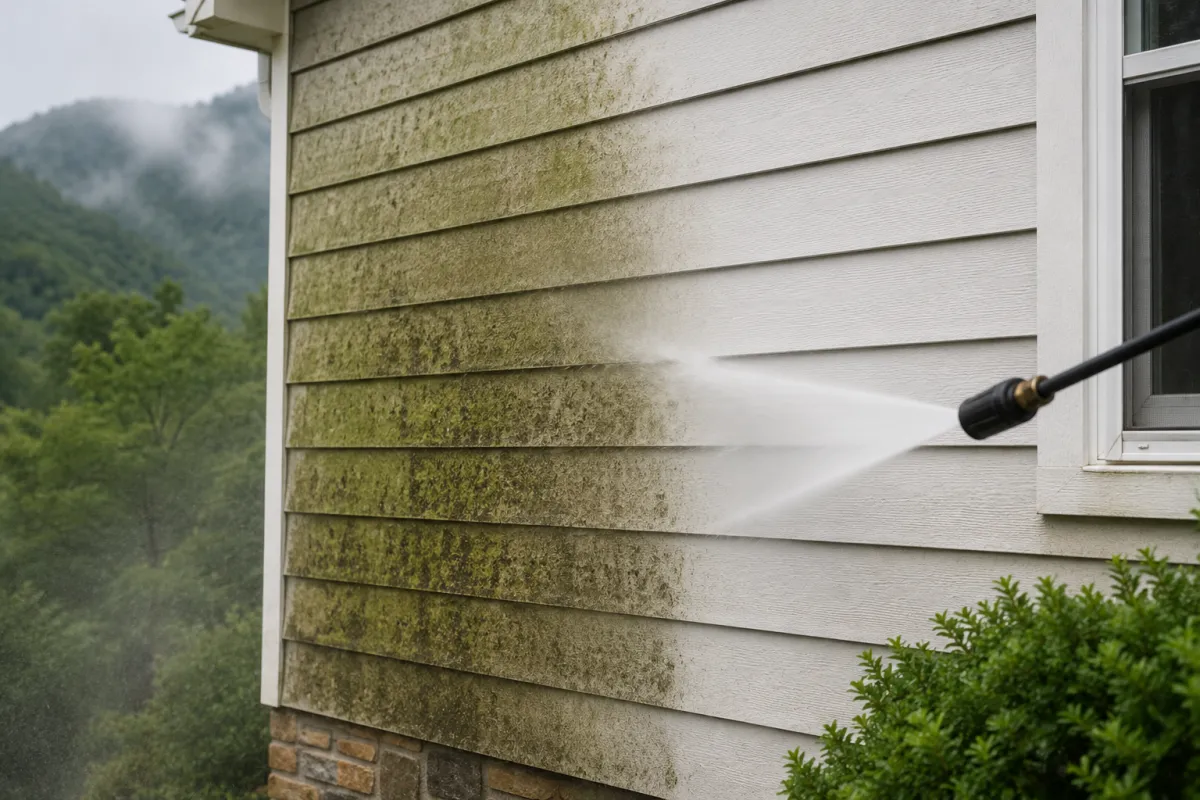
Walk any Jasper home and the growth is worst on the shaded side, worst near the ground, and worst wherever a downspout, a hose bib, or a section of gutter is dumping water down the wall. Those are the spots that stay wet longest, and mildew simply follows the moisture.
What homeowners often miss is that mildew on siding is not sitting on top like dust. It works into the texture, into the seams between courses, and into the porous surface of painted wood or stucco. Rinsing the surface makes it look better for a week or two, then it comes back looking exactly the same, because the colony underneath was never killed. That is the difference between rinsing a house and washing one.
Why the Wrong Method Does More Damage Up Here
Older Brick, Cedar, and Cabin-Style Builds
Pickens County housing stock leans older and more varied than the newer vinyl subdivisions filling in around Canton.
Up here you find hand-laid brick with soft lime mortar, cedar and board-and-batten siding, log construction, painted wood trim on homes built decades before HardiePlank existed, and stone accents that were sourced locally. Every one of those materials is more porous, softer, or more finish-dependent than modern vinyl.
Soft mortar erodes under a pressure tip and does not grow back. Cedar furs and gouges. Painted wood loses its coating in strips. Stone and grout wash out at the joints. On a fifteen year old vinyl house, a bad wash is a bad idea. On a forty year old mountain home, a bad wash is a repair bill with a carpenter attached.
Why High Pressure Is the Wrong Answer on Every One of Them
High pressure feels like it should work harder. That is the intuition, and it is wrong on almost every exterior surface.
Pressure removes what it can blast off the surface. It does not kill the organism, and the roots of algae, mildew, and moss go into the surface, not across it. So pressure takes off the visible layer, leaves the colony intact, and damages the material on the way through. Two months later the growth is back on a surface that is now more porous than it was before, which means it grows back faster.
Soft washing works the other way around. A properly diluted cleaning solution kills the organism at the root, dwells long enough to do its work, and then rinses at a pressure closer to a garden hose than a pressure washer. Nothing gets stripped, nothing gets gouged, and the result lasts because there is nothing left alive to regrow.
The part that matters is dilution, and it is the part most operators get wrong. Too weak and you are just wetting the house. Too strong and you are killing landscaping and stripping finishes. Getting that ratio right for the specific surface, in the specific conditions, is the actual skill in this trade.
What Jasper Homeowners Should Actually Schedule
The Right Cleaning Cadence for a Mountain Home
The general Georgia guidance is a house wash every twelve to eighteen months. For a shaded Jasper home under canopy, plan on the front end of that, and in some cases tighter.
A good way to judge is to look at the north side of your house in late summer. If there is visible green or gray haze building along the lower courses and under the eaves by August, you are on a twelve month cycle. If it still looks clean going into fall, eighteen months is fine.
Roofs are slower but less forgiving. A soft wash every three to five years keeps algae and moss from establishing. The catch is that once moss is thick enough to see clearly from the driveway, it has usually been working under the shingles for a while, so waiting for it to look obviously bad is waiting too long.
Which Surfaces to Do First
If you are only doing one thing this year, do the roof.
Roof growth is the only exterior problem on this list that shortens the life of a major building component. Moss holds water against shingles and lifts their edges. That is a roof replacement timeline moving toward you, and a roof replacement is not in the same universe of cost as a cleaning.
After the roof, work top down: house wash, then gutters, then decks and concrete. That order matters because everything you clean sends dirty water down onto whatever is below it. Cleaning the driveway before the house means cleaning the driveway twice.
One more note specific to mountain lots. Concrete and stone walkways on shaded slopes get genuinely dangerous. Algae film on wet stone is slick in a way that surprises people, and steps and pathways cut into a grade are exactly where you do not want a slip. If your walkway looks slightly green, it is slick, and that is a safety item, not a curb appeal item.
Frequently Asked Questions
Do you service Jasper and Pickens County?
Yes. Grime Fighters is based in Tate, which puts Jasper and the surrounding Pickens County area directly in our home service area, along with Ball Ground, Canton, and Woodstock. We work on mountain homes regularly, including cabin, cedar, and older brick construction, and we handle house washing, roof soft washing, concrete, decks, fences, and gutters.
Why does my Jasper home get dirtier than my old house in the metro?
Elevation and shade. Higher ground means cooler temperatures and more fog and cloud contact, and heavy tree canopy blocks the sun that would otherwise dry your siding and roof after rain. Surfaces that stay damp longer give algae, mildew, and moss more hours to grow, and the canopy also drops a constant supply of pollen, leaf litter, and needles that feed that growth. Same house, different conditions, faster buildup.
Is moss on a roof treated differently than algae?
Yes. Algae is a flat bacterial staining that responds to a soft wash treatment and rinses away relatively quickly. Moss is a plant with structure and root-like attachment that grows under and between shingles, and it holds water against the roof. Moss has to be killed with treatment and then allowed to die back and release over several weeks. Scraping or blasting it off takes shingle granules with it and does more harm than the moss did.
How often should a shaded mountain home be washed?
Plan on a house wash every twelve to eighteen months, leaning toward twelve for homes under heavy canopy or on north-facing slopes. Roofs generally need a soft wash every three to five years, sooner if moss is visible from the ground. The most reliable test is the shaded side of your house in late summer. If green or gray haze is building by August, you are due annually.
Grime Fighters offers free estimates across Jasper, Ball Ground, Canton, and Woodstock. Send us your address and we will get you a real number without a three day wait.