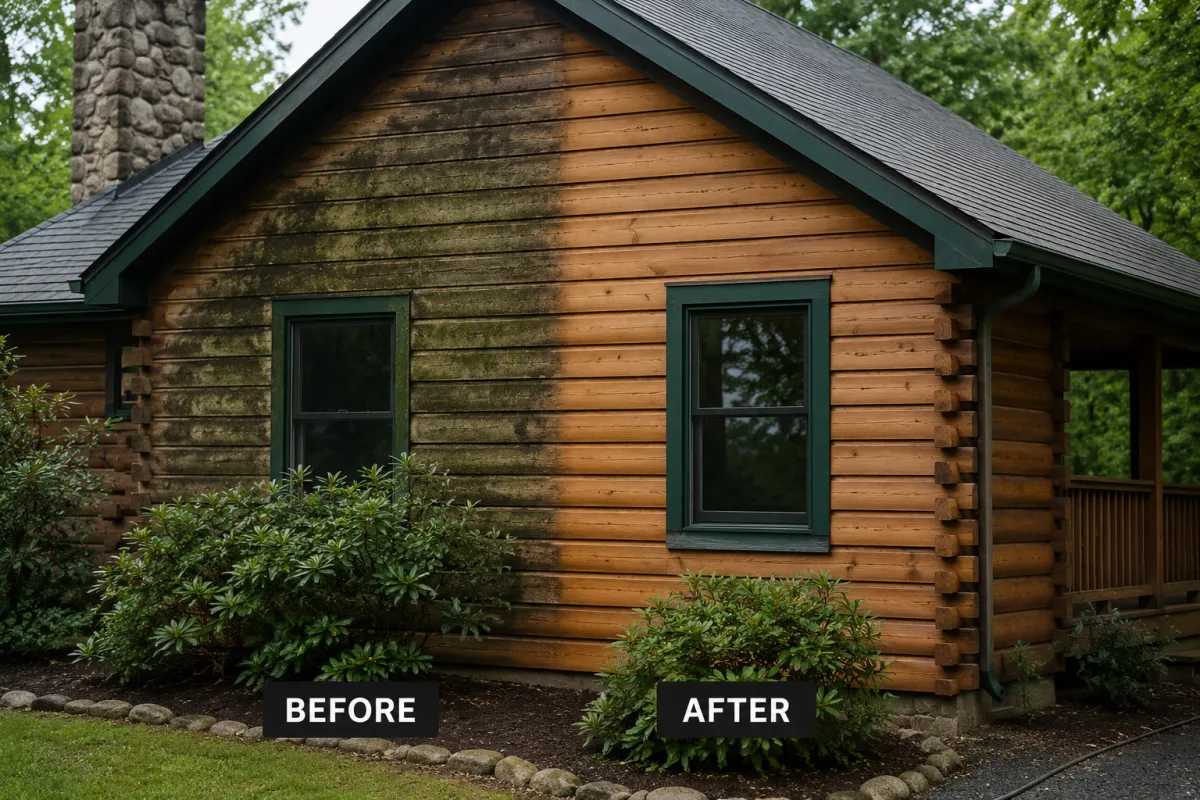
Cleaning Cabin and Cedar Siding in the North GA Mountains
Overview
Cabin and cedar siding cleaning in the North Georgia mountains is not the same job as washing a vinyl house, and treating it that way is how people end up with a blotchy, furred exterior and a re-stain bill. Cedar, log, and cabin-style homes common in Big Canoe, Bent Tree, and the wider Pickens County mountains are built from soft, absorbent wood finished with penetrating stains and sealers that both high pressure and aggressive chemistry will strip. The correct approach is a wood-safe cleaning solution at the right dilution, applied at low pressure, matched to the specific finish already on the home and tested in a small area before the whole exterior gets touched.
Have a cabin or cedar home that needs attention? Grime Fighters works on mountain homes throughout Pickens County. Get a free estimate before anybody puts a pressure washer near your wood.
Why Cedar and Log Homes Are a Different Job Entirely
Soft, Absorbent Wood and What It Holds
Cedar is popular in the mountains for good reasons. It is naturally rot resistant, it holds stain beautifully, and it looks right on a wooded lot. It is also soft.
On the Janka hardness scale, western red cedar sits near the bottom of what gets used as building material. You can dent it with a thumbnail. Its cell structure is open and absorbent, which is exactly why it takes stain so well, and it is also why it takes in water, holds it, and gives mildew a place to live below the visible surface.
That is the core issue. On vinyl, growth sits on top. On cedar and log, it grows into the wood. A surface rinse takes off the top layer and leaves everything under it intact, which is why a cabin that got hosed off in June looks gray again by September.
Log homes add another dimension. The checks and cracks that develop as logs season are moisture traps, and the horizontal top surface of each log course collects water and debris in a way a flat wall never does. Those are the areas that fail first, and they are also the areas that a careless wash drives water directly into.
Stains and Sealers That Chemistry Can Strip
Every cabin exterior in Big Canoe or Bent Tree has some finish on it, and knowing which one changes the entire approach.
Penetrating oil stains soak into the wood and weather by fading. Film-forming stains and sealers sit on the surface and weather by peeling. Some homes have a clear sealer over a stain. Some have three different products applied by three different contractors over twenty years. Some have a solid body stain that behaves more like paint than a stain.
Sodium hypochlorite, the base of most exterior cleaning solutions, will lighten and strip finishes if the dilution is wrong or the dwell time runs long. Get it right and it kills mildew and leaves the finish alone. Get it wrong and you have bleached the stain out of the sunny wall, and the only fix is stripping and re-staining the whole house so it matches.
That is the real reason cabins need a different process. It is not that the wood is fragile in some abstract way. It is that the finish is the expensive part, and the finish is what a generic wash puts at risk.
What Goes Wrong When a Cabin Gets Treated Like a Vinyl House
Stripped Finish and Blotchy Color
The most common damage is not dramatic. It is patchy.
A crew shows up with one mix for the whole house, runs it hot enough to handle the worst wall, and the shaded north side comes out clean while the sun-faded south side comes out several shades lighter than it started. Or the solution sits too long on one section while the crew works elsewhere, and that section bleaches while the rest does not.
The result is a house with tonal patches that did not exist before, and there is no touching that up. Stain does not blend. Once the color is uneven across a wall, the fix is stripping the whole elevation and re-staining, and on a large cabin that is a five figure job.
There is a related problem with tannin. Cedar and redwood are full of natural tannins, and certain chemicals pull them to the surface and leave brown or rust-colored bleeding down the wall. It looks like the house is rusting. Treating that requires a neutralizing rinse, which somebody has to know to do.
Furred Grain and Water Intrusion
Pressure damage on cedar happens faster than most people expect.
Water at pressure separates the soft early growth wood from the harder late growth rings. The visible result is furring, where the surface lifts into a fuzzy raised texture, and in worse cases actual grooves cut into the board following the grain. It often does not look bad while it is wet. It shows up as the wood dries, which is why homeowners approve a job that looked fine at three in the afternoon and see the problem the next morning.
Furred wood is also permanently worse at everything. It absorbs more water, sheds stain unevenly, and gives mildew more surface area to colonize. The house now grows back faster than it did before it was cleaned.
On log homes the risk goes past cosmetics. Pressure directed at a horizontal joint, a check, or a chinked seam pushes water into the log body and behind the chinking. Logs dry from the outside in, so water driven deep does not come back out quickly, and trapped moisture inside a log is how rot starts in a home that looked perfectly sound from the driveway.
The Right Approach for a Mountain Cabin
Wood-Safe Solution at the Right Dilution
The process on a cabin is slow, and the slowness is the point.
It starts with pre-wetting the wood and thoroughly soaking any landscaping in the splash zone. Saturating the wood first means it absorbs less of the cleaning solution, which keeps the chemistry working on the surface where the mildew is rather than soaking into the boards.
The solution goes on at a dilution set for cedar and for the finish on the house, which is significantly gentler than what goes on vinyl siding or concrete. It is applied at low pressure, closer to what comes out of a garden hose than a pressure washer, and it is worked in manageable sections so nothing dries on the wall.
Dwell time gets watched closely. The solution needs enough time to kill the mildew and not one minute more, and on a warm sunny wall that window is short. Sections get rinsed before they dry, then the whole elevation gets a final rinse from the top down. On tannin-prone wood, a neutralizing rinse follows.
Soft brushing by hand handles the areas that need mechanical help, particularly log courses and heavily textured board-and-batten. Hands and a brush, not a pressure tip.
Testing the Finish Before Cleaning the Whole Home
No two cabins in Big Canoe have the same finish history, so nobody should assume they know what is on yours.
That is why a test patch matters. A small area in a spot nobody looks at, a section of wall behind a downspout or under a deck, gets the intended solution and dwell time. Then it gets rinsed and given time to dry, because wet wood tells you nothing about what the finish is going to look like.
What the test shows: whether the finish holds or lightens, whether tannins are going to bleed, how much dwell the mildew actually needs, and whether the dilution should come down. If the test patch lightens, the mix gets adjusted and tested again before anybody moves to the front of the house.
It adds time to the job. It is also the entire difference between a clean cabin and a stripped one, and any operator who skips it on a stained wood home is guessing with your finish.
Protecting the Home After the Wash
Re-Staining and Sealing Timelines
A lot of cabin owners clean specifically because they are getting ready to re-stain, and the timing between the two matters more than people think.
Cedar and log need to be genuinely dry before any finish goes on, and dry means dry through, not dry to the touch. In the North Georgia mountains, where humidity is high and shaded walls hold moisture, plan on a minimum of two to three dry days after a wash before staining, and longer for log walls or any stretch of cool damp weather. A moisture meter is the honest answer if you want to be certain.
Stain applied over wood that is still holding water does not penetrate. It sits on the surface, cures poorly, and fails early, usually by peeling within a season or two. The wash was supposed to prepare the surface, and rushing this step wastes it.
If the plan is a full strip and re-stain rather than a clean, that is a different process using a stripper and often a brightener, and it should be handled as its own project with its own timeline.
A Realistic Maintenance Cadence for Cabin Exteriors
Mountain cabins need attention more often than metro homes, and it is worth planning for rather than reacting to.
A maintenance wash every twelve to eighteen months keeps mildew from establishing deep in the wood. Homes on heavily shaded lots, north-facing walls, or anything close to a creek or low ground will be at the twelve month end. A cabin that only gets cleaned every four or five years is not getting maintained, it is getting rescued, and rescue work is harder on the finish.
Stain and sealer timelines depend on the product and the exposure, but a general expectation for a penetrating stain in this climate is three to five years on sun-exposed elevations and longer on protected ones. Uneven fading between walls is normal and is a sign of exposure, not of a bad job.
The watch item between services is anywhere water repeatedly hits wood. Splash-back at the base of walls, gutters overflowing onto siding, a downspout dumping next to the foundation, deck boards holding standing water. Fix the water problem and the wood problem mostly takes care of itself.
Frequently Asked Questions
Can a log cabin be pressure washed at all?
Not with high pressure. Pressure separates the soft grain in log and cedar walls, furs and gouges the surface, and drives water into checks, chinking seams, and log joints where it stays trapped and can start rot. Log and cabin exteriors should be soft washed with a wood-safe solution at low pressure, with hand brushing where mechanical help is needed.
Will cleaning strip the stain off my cedar siding?
It should not, if the dilution and dwell time are set for the finish that is on your home. Stripping happens when a solution is mixed too strong or left on too long, which is why a test patch in a hidden area is done first on any stained wood home. A properly executed soft wash removes mildew, algae, and surface grime while leaving the stain intact.
Do you service Big Canoe and Bent Tree?
Yes. Grime Fighters is based in Tate, which is just down the road from both communities, and we work on cabin, cedar, and log exteriors throughout Big Canoe, Bent Tree, Jasper, and the surrounding Pickens County mountains. We also handle roofs, decks, gutters, and concrete on those properties.
How soon after cleaning can a cabin be re-stained?
Give it a minimum of two to three dry days, and longer for log walls or if the weather stays cool and damp. Cedar and log hold moisture well below the surface, and stain applied to wood that is still wet inside will not penetrate properly and tends to fail early. If you want certainty, check the wood with a moisture meter before the first coat goes on.
Grime Fighters offers free estimates for cabin and cedar homes across Big Canoe, Bent Tree, Jasper, and Ball Ground. Send us your address and we will walk you through the right approach for your finish.